Monday, June 29, 2009

Not if or when but which and how

by Elizabeth Corley

When the organizer for Blog Potomac, declared last week that social media was dead, he meant it was alive and well. He explained that it is doing so well that an innovator such as himself had to move on. In terms of technology life cycles, if you don’t have a blog by now, you are behind the curve.

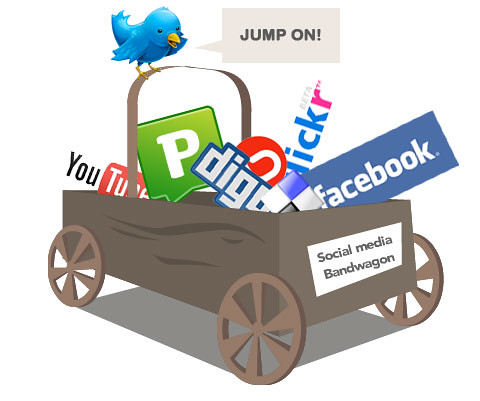
It is not too late to jump on the bandwagon. (Thanks to Matt Hamm for this image.) The challenge is how to make it work for you. It is not a question of if or when to use social media, but which tools and how.

Development Gateway uses a number of social media platforms to communicate with our stakeholders. The enhanced version of dgCommunities, the platform we provide for information on development, is scheduled for launch in the coming weeks. It will make sharing content easier and has been designed with social features. In addition to this blog, we use several other platforms such as Twitter.

We added Twitter to our toolbox because of its speed and flexibility. It is one way we share knowledge on what is going on in international development and inside the organization. It has helped us connect with people who care about aid effectiveness.

Twitter has been mentioned frequently in the news lately. First, as an application that will change the way we live, according to Time. Then, it was examined in light of the Iranian elections. More recently it became the subject of attention when Michael Jackson, the King of Pop, died on June 25, and tweets jumped to 5,000 a minute. (Sounds like a lot, doesn't?)

Our Twitter updates are integrated into a broader communications strategy that puts the Web site at the hub. Our tweets reference the Web site but go beyond our programs to help promote other notable efforts and engage in less formal conversations with our followers. Other tools, such as Facebook, LinkedIn, this blog, and the ning, are vehicles for communication and knowledge sharing. Each one has its own role. The trick is to use them well you need to be driving the wagon, not bouncing around in the back.

Friday, June 26, 2009

Six steps to managing an international team


by Alex Coleman

This is the first in a series of six blog entries describing the management process used by the AMP technical team. The team consists of 20 software engineers in Argentina, Burkina Faso, Georgia, Finland, Morocco, and Romania. We also have 6 technical specialists in Washington, Dakar, and Nairobi. The team supports 11 AMP installations in Bolivia, Burkina Faso, Burundi, DRC, Ethiopia, Malawi, Montenegro, Niger, Senegal, and Tanzania.

1. Over Communicate (Provide various channels of communication)

There can never be too much communication with your team horizontally and vertically. Communication is imperative because of the distance and increased probability of a misunderstanding of requirements. It helps foster the team spirit crucial to the success of the program.

The various methods of communication are:

  • Chat. On a daily basis, we use an internal chat system-AMPCHAT. All the technical team members are required to be available on this chat during work hours. We also use chat systems such as MSN, Skype, and YAHOO as backup options. Encourage developers in different countries to use the chat systems and SIP phones to discuss technical issues.

  • Webex. This online tools works well for international calls, demonstrations, and recording of meetings.

  • Teleconference. We hold a quarterly teleconference team meeting to outline the management and technical direction for the upcoming months.
  • E-mail. Electronic mail, combined with teleconferences and chats organized by technical specialists, is good for smaller teams for the kickoff and development of a new feature. Various daily meetings are held to discuss the feature requirements, project plan, and ongoing updates. These methods are also good for upgrade and installation planning.

  • Telephone. Old-fashioned technology still has its place. Phone interviews for new hires are important to encourage direct communication and a team spirit.

  • Face-to-face. Upon hire, new team members are paired up with senior developers. This sometimes takes place in another location. Working side by side for a period of two months helps the new hire to understand our software development process.
My next post will focus on step 2: Nurturing the team

Until 2015: How can we optimise the implementation of the MDGs?

by Anna Lauridsen

This week, development practitioners, experts and academics gathered in Brussels to discuss the state of play of the Millennium Development Goals at After 2015: Promoting Pro-Poor policy After the MDGs. Co-organised by DFID, ActionAid, the EADI, and the Development Studies Association, the event attracted panelists from across the development field.


The conference set out to tackle two ambitious questions: 1) What has been the impact of the MDG paradigm on poverty reduction to date and what does that mean for an MDG plus agenda? and 2) What are the key meta-processes shaping development over the next 10-15 years and what do they imply for an MDG plus agenda? The conclusions from the conference were meant to feed into the upcoming 10 year review of the MDGs in 2010.

Despite the doom and gloom surrounding the MDGs and how they are not expected to be achieved (especially in the light of the financial, food and fuel crises) a few suggestions were made on turning the situation around, or at least improving it. Some speakers suggested a new paradigm of global sustainable development, including poverty, and others proposed additional millennium goals of social inclusion. However, at this point in time, what is really needed? If the MDGs are failing, would it really be wise to add new ones at this stage? Are we risking an intellectualisation of the MDGs, and of development at large? Perhaps the answer is more practical and straightforward and less high-level and policy oriented.

To date, the MDGs have worked and failed to various degrees in different countries. As most of the developed and developing world has entered the information and communication age it is high time to ask how this change could benefit the poor. Undoubtedly, MDG 5 of improving maternal health, which has been the biggest failure across the board, could have been alleviated by better infrastructure and information, but also by the use of information technology. There is no question that the use of mobile phones and other web based tools to exchange information must be further explored and integrated in all development work.

Finally, to what extent can countries learn from each others' success and failures? How could a system for peer review be set up among countries implementing the MDGs in order for them to monitor each others progress? Is there for the possibility for more locally defined measures and indicators? Louis Kasekende highlighted how the tracking of progress is undermined by the lack of current and reliable data and how poor quality of data makes monitoring difficult. The multiplicity of players also contributes to a lack of coherence, coordination, and duplication of effort. The need for reliable data and targets points to yet another role ICT can play in achieving the international development agenda.

The conference provided the opportunity to discuss the approaching deadline of the MDGs and what can be done to ensure that all of the efforts used to achieve them – regardless of success – was not completely wasted. The questions raised by the participants show clearly that there is a growing need for information and communication technology in the future of development.

Please consult http://www.thebrokeronline.eu/ for further reading

Thursday, June 25, 2009

Holding donors accountable

by Emily Kallaur

The ONE Campaign recently released its DATA Report 2009, which tracks the G8 countries’ actual aid delivery against the pledges made at the 2005 Gleneagles summit. This report is a great example of leveraging aid information to hold development actors accountable for their promises. Overall, the analysis finds mixed performance across donor countries; in total, about one third of the aid increases promised by 2010 have been delivered. Clearly progress will have to accelerate if the targets are to be met (although some individual donors are meeting or even exceeding their individual commitments). In addition to increasing the quantity of aid, the report highlights the need to improve the quality of delivery—for example, relying on local country systems rather than donor systems to manage aid flows. But of course, aid is only part of the story. Having made little progress on “making trade work for Africa,” it’s time for the G8 to take some meaningful steps toward facilitating increased trading opportunities.

Wednesday, June 24, 2009

Five Sites Every Conscious Citizen Should Know About

by Nadia Afrin

Global Voices Online – www.globalvoicesoline.com
Want an alternative to mainstream news media? Want to know what people around the world are really thinking? Global Voices Online can give you the global pulse by aggregating commentaries from 200 bloggers worldwide. Global Voices also runs the Lingua project and translates blog entries in 15 languages.

Global Giving – www.globalgiving.com
Global Giving is the “marketplace that connects people who have community and world-changing ideas with people who can support them”. It compiles a list of credible development projects around the world and ensures that they meet IRS and anti-terrorism regulations. Individuals who are interested in donating to a good cause can find projects by sector and country. We set up a wedding registry on Global Giving when we got married and raised over 1,000 dollars for projects we picked out!

Ammado – www.ammado.com
Ammado is social networking site that brings together non-profts, socially-minded businesses, and conscious citizens around the world. Businesses can use it to promote awareness about their CSR initiatives as well as forge partnerships. Non-profits can communicate information about their activities to people around the world. Individuals can get up-to-date information about their favorite non-profits, create giving circles to fund development projects and connect with like minded people. Since its launch in June 2008 the membership of Ammado has grown substantially. The site is now available in 12 languages.

TED – www.ted.com
TED was created on the notion that ideas have the power to change our world. TED hosts an annual conference that brings together thinkers and leaders in science/technology, business, arts etc. 400 of the best TEDTalks are available on their website with subtitles in various languages.

dgCommunities – www.dgcommunities.com
Last but not the least is our very own dgCommunities. It provides a space for professional learning and knowledge-sharing among those working to reduce poverty worldwide. We are making big improvements to dgCommunities and rebranding it in an effort to better meet your needs. Among other things, we are expanding out coverage from the current 30 topics to a wide range of development issues. Look out for the new and improved dgCommunities!