Monday, May 17, 2010
Clinton Lauds DG Haiti Partnership

Thursday, April 22, 2010
Intern blog: Earth Day's 40th anniversary
Rich countries have the capacity to do their part in climate mitigation and adaptation. But what about developing countries? Reducing debt burden, dealing with balance-of-payments, as well as managing numerous aid projects among many other problems, it is difficult and costly for these countries to also tackle climate change.
Thursday, April 15, 2010
Intern blog: On fungibility of aid
Tuesday, April 13, 2010
Good Neighbor Policies
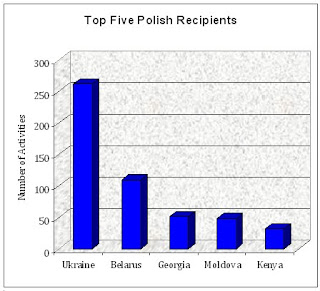
However, Poland also appears to look after its own citizens abroad. AidData reveals how Poland consistently funds activities in countries where Polish troops or peacekeepers are stationed. As foreign assistance shifts farther and farther away from traditional lending from large Western countries, it will be interesting to keep an eye on
Friday, April 9, 2010
Where Have the Cows Gone?

This week Development Gateway attended the first meeting of the advisory committee for InterAction's Mapping Initiative. InterAction, for those who don't know, is an umbrella organization that represents hundreds of U.S. non-governmental organizations. Together with FortiusOne (the organization behind the incredibly cool Geocommons online mapping tool), InterAction is working with a small group of their member organizations to create a standard output format for NGO development projects so they can be easily compared and, of course, mapped. Although the location of aid projects will likely be aggregated at the provincial level to protect the privacy of the recipients, this tool could in theory create a map that displayed where each cow that Heifer International donated had gone. It could probably even make the points spotted.
The implications for aid transparency are enormous. Thousands of NGOs are involved in international development, and at the moment there is no systematic way for stakeholders to look at where these organizations are operating and what is being funded. If a picture is worth 1,000 words, imagine a map that could overlay the work of 1,000 organizations against indicators like child malnutrition or climate vulnerability to show areas where help is still needed. Knowledge is a powerful tool.
Thursday, April 8, 2010
Intern blog: Haiti & aid transparency
Tuesday, March 30, 2010
AidData: Aid Transparency in Action
The best news for the team, however, has been the overwhelmingly positive feedback that AidData has gotten since going public. In its first week, the website had over 30,000 hits and AidData has been mentioned in dozens of high-profile blogs and news outlets as a positive influence on aid transparency and effectiveness.
To check out AidData, go to www.AidData.org.
Thursday, March 4, 2010
Intern blog: Aid Information Challenge
In the process, I've been spreading the word and got to thinking about the core purpose of these events. There seems to be a general consensus now that transparency is crucial for development aid. Not only are we striving to do this with our programs and technology, but we are also trying to achieve this through the unconference. In a field or within an organization, encouraging dialogue and input is a great way to facilitate new ideas. We're providing the statistics and data and you can help us come up with effective ways to use and implement it!
Thursday, February 25, 2010
My life as a Development Gateway intern
Wednesday, February 17, 2010
Tame the beast
A recent article in The Economist about data and transparency addresses the possible downsides of open government data. While the article sites some positive examples of efforts governments have made to make data more open, it acknowledges that, “whatever governments do, the presentation of endless facts can fall flat unless there are independent developers who know what to do with them.”Tuesday, January 19, 2010
Greetings for the New Year
As a tribute to all our friends and family, the first blog post of the new year features a photo of the participants at the annual knowledge-sharing workshop for AMP, held in Dakar during the first week in December. Without these stakeholders our aid management program would not be as robust. The participants impressed us with their spirit of collaboration and with the knowledge and experiences they shared. The workshop gave us insights into how different countries are addressing issues of aid management. It also gave us some ideas for add-ons to the system. More importantly, it showed us a real example of South-South collaboration. We thank all of the attendees for making the event a success.The year ended in a rush of activity as the workshop came to an end and then we embarked on a strategic planning process. That process is now under way. We have much to look forward to in 2010. AidData, a user-friendly global repository of development activities, will be launched in March. The aid management program will open its Asian market with an implementation in Laos. And, we will host a follow-on to the Open Development camp. Look here for more details.
Friday, November 20, 2009
The team behind our global IT solutions
An international team of developers supports our diverse offering of technical solutions. These individuals work on AiDA, the aid management program, dgMarket, and Zunia, in addition to projects for clients such as UNDP and AFD. They are based in Tuesday, November 17, 2009
Three things you should know about IATI
1. The intent of IATI is not to create a database. The aim is to establish a common set of standards and definitions, and a code of conduct for donors.
2. Aid information management systems at the country level do not replace the Creditor Reporting System of the OECD, rather they are complementary. Read the study that compares data reported to the CRS and aid management systems in Malawi and Burkina Faso. Rudolphe Petras of Development Gateway conducted the study, analyzing information in two implementations of the Aid Management Platform.
3. While the primary emphasis is on donors, civil society organizations also share the responsibility for transparency.
So far 18 signatories are committed to the process. The goal of establishing common information standards by the end of this year will probably not be met. Still, there is much interest as the need for increased transparency is great.
The report from the conference is here and the program with links to presentations is here.
Friday, October 9, 2009
Partners on a quest to make aid data transparent
We're back! And a lot has been happening. Look here for updates on IATI, European Development Days, and events like our photo contest and future barcamps.This week we announced our partnership with PLAID and our aim to create a comprehensive repository of development data, easily accessible to all. AidData, as the joint venture is called, will have all the content of AiDA and much more. Captured in the photo are two happy people who have been working hard to make this venture a reality, Riccardo De Marchi Trevisan, manager of AiDA, and Jessica Sloan, associate director of the Institute for the Theory and Practice of International Relations at the
Friday, August 14, 2009
August Break
Tuesday, August 11, 2009
A bi-partisan change to USAID
On July 28, a bipartisan group of U.S. Senators, including Senators John Kerry of Massachusetts and Richard Lugar of Indiana, introduced a bill to improve U.S. development efforts by updating the U.S. Agency for International Development (USAID) for the 21st century. The introduction of this bill was part of a larger effort to improve USAID and increase its role in U.S. development efforts.
Senator Lugar has been particularly vocal in his support of changing the way USAID conducts business. He has written an op-ed in which he outlines many of the features to be found in the bi-partisan bill, including the need for increased staff and tracking project outputs to determine successes and best practices. Recently, Senator Lugar wrote a letter to the editors of the Washington Post to highlight the difficulty the Obama administration has had in finding a USAID Administrator.
In addition to the bi-partisan support and momentum this bill represents, it is a new commitment of USAID to the goals of transparent data and the measurement of its activities. Both Sections five (page nine of the bill in particular) and section six of the bill highlight the need for USAID to collect data and perform monitoring and evaluation assessments on their programs. These sections of the bill will improve the effectiveness of USAID’s efforts and possibly provide the development community as a whole with best practices and certainly with a surfeit of data on USAID’s activities.
To ensure that the information USAID will now collect will be used, Section 10 of the bill recommends that the U.S. fully engage and comply with the International Aid Transparency Initiative (IATI). IATI was one of the outcomes of last year’s high level forum in Accra. The type of transparent information IATI compliance would entail will give U.S. and international aid practitioners a greater wealth of information to ensure more effective aid.
The two parts of the bill highlighted here are clearly related. There is little point in collecting all of information USAID will be required to collect if no one will ever see it. The two major points are also key issues for Development Gateway. Aid effectiveness has been a key point of our work and we have begun to emphasize the possibilities that more transparent information can offer. We look forward to the progression of this bill and hope that whatever final version is submitted to President Obama for his signature contains these provisions to ensure more transparent, effective aid.
The full text of the legislation is available here.
Friday, August 7, 2009
Comparing Aid Agencies
Ariel BenYishay and Franck S. Wiebe of the Millennium Challenge Corporation have just written a paper entitled “Can Aid Agencies Follow Best Practices?: An Assessment of the MCC’s Aid Practices Based on Easterly and Pfutze (2008)”. The paper assesses the MCC’s performance according to indicators of aid agency “best practice” as determined by Easterly and Pfutze.
In the original paper by Easterly and Pfutze, all U.S. agencies providing aid were evaluated in the aggregate. Although (to date) the MCC disburses only a small fraction of total U.S. development assistance, its approach and policies are quite innovative and contrast sharply with other U.S. agencies which follow a more traditional approach, making the MCC a compelling individual case study. When applying the Easterly and Pfutze evaluation criteria solely to the MCC rather than U.S. aid agencies as a whole, BenYishay and Wiebe find that it ranks 8th out of 40 donors, compared to 16th out of 39 for U.S. assistance as a whole.
It’s certainly debatable whether there are universal “best practices” for aid agencies, and if so whether Easterly and Pfutze have correctly identified them. In any case, this result for the MCC is an interesting contribution to the debate.
Friday, July 24, 2009
Enough with the kids, already
A picture is worth a thousand words, so they say. But what are those words actually saying? Too often the image we get of development is poor people, frequently children, looking bereft. While these images can be compelling and evocative of those we aim to benefit, they don’t depict aspects of development that involve economic growth.We are always looking for images that help show the many sides of development. The annual Development Gateway photo contest is now under way. Show us what you think is a great image of development, in all it manifestations. The winner will receive $1,000. Send in your submissions by September 18, 2009.
Pictured here is one of my favorites from last year. It shows a woman harvesting seaweed in Madagascar. The photo was taken by Laura DeBiaggio of Italy.
Relationship building - the overlooked ingredient of effective aid?
IDS researcher, Rosalind Eyben recently responded to the call from the UK All-Party Parliamentary Group (APPG) for Debt, Aid and Trade for evidence on aid effectiveness. Her response focuses on the importance of relationships.
Eyben argues that effective aid requires as much investment in relationships as in managing money. Hence, development organisations need to change the way they work in order to better manage the multiple partnerships that the Accra Agenda for Action recognises as the core of the aid business.
Part of the problem is the way aid is measured. Currently, the approach assumes that we are in control and that change is predictable. If you do X, Y will follow. Although this approach may be useful for programmes involving mass immunisation campaigns and impregnated bed-nets, in many aid cases change is not predictable or controllable.
In fact, Eyben’s inquiry reveals some effects are simply not reported by development staff because they were not predicted or did not fit the initial logical framework. Eyben points to cases of relationship building on the local level in conflict ridden countries as some of the most effective initiatives. Eyben states that there is no evidence that spending more money with less staff will deliver better results. This observation is due to the fact that achieving impact requires investing in relationships, which requires the support of development organisations.
Staff can understand the specific context in which they are working through investing time in building relationships with different individuals, organisations, and networks. Similarly, the organization’s staff needs to engage with diverse citizen’s groups (in the capital and in the countryside) as well as with government officials, including front-line workers, in order to get a better picture of what is happening and to identify drivers and blockers of change.
Read the full report: Evidence Submission to the APPG Inquiry on Aid Effectiveness
Friday, July 17, 2009
Making sense of aid flows
Through AiDA (the Accessible Information on Development Activities) database we are trying to provide an increasingly comprehensive picture of development assistance flows around the world. I just came across a picture that illustrates how challenging this problem can be—it’s from a 2007 paper entitled “Trends and Issues in Development Aid,” by Homi Kharas of the Brookings Institution.

It’s quite a complex web! In recent months we have added data feeds from more private aid organizations to AiDA, and we are working to capture more. The more information can be reflected in a single repository, using a single format, the better development actors will be able to assess where funds are going and how they are being used.
The paper and diagram above also highlight the relatively small share of development aid that makes it to countries as “programmable aid.” The definition of programmable aid excludes debt relief, humanitarian and food aid, technical assistance, and donors’ administrative costs—not because these are not worthwhile, but in order to zero in on the aid flows that can be used by recipient governments to invest in development. Kharas found that only about $38 billion of the over $100 billion in official development assistance from OECD/DAC member states was channeled to developing countries as “net programmable aid” (as of 2007). For Sub-Saharan Africa, net programmable aid of about $12 billion in 2005 was approximately the same amount (once adjusted for purchasing power) that was delivered in 1985.
This situation underscores the need for detailed, standardized data on aid flows in order to understand what is really happening on the ground, and gauge its impact. Another implication is that recipient governments need aid information that can be easily disaggregated into programmable aid, that they can reflect in the national budget and direct toward development priorities, and other types of aid (such as technical assistance) which do not represent financial flows to the country. Currently this level of detail is not necessarily the case.