Showing posts with label Development Gateway. Show all posts

Friday, July 24, 2009

Enough with the kids, already

by Elizabeth Corley

A picture is worth a thousand words, so they say. But what are those words actually saying? Too often the image we get of development is poor people, frequently children, looking bereft. While these images can be compelling and evocative of those we aim to benefit, they don’t depict aspects of development that involve economic growth.

We are always looking for images that help show the many sides of development. The annual Development Gateway photo contest is now under way. Show us what you think is a great image of development, in all it manifestations. The winner will receive $1,000. Send in your submissions by September 18, 2009.

Pictured here is one of my favorites from last year. It shows a woman harvesting seaweed in Madagascar. The photo was taken by Laura DeBiaggio of Italy.

Tuesday, July 7, 2009

Innovations in Development Financing

by Emily Kallaur

Recently Development Gateway hosted a brownbag led by Navin Girishankar of the World Bank, who presented his new paper “Innovating Development Finance: From Financing Sources to Financial Solutions”.

The paper takes stock of creative financing mechanisms for development, from solidarity mechanisms like the Stolen Asset Recovery (StAR) initiative to risk management tools such as weather indexed insurance for Malawi. In an effort to mobilize resources to support achievement of the MDGs, donors have also turned to new sources of funding for development initiatives, such as proceeds from national lotteries (in the UK and Belgium) or levies on air travel.

Overall, innovative financing still accounts for a fairly small share of total development aid. The paper concludes that innovative financing should be increasingly mainstreamed, but that it is not a substitute for raising the overall volume of development assistance through traditional means (e.g. for concessional financing). According to the analysis, the only major new source of concessional financing in the period studied has been aid from emerging bilateral donors (non-DAC members), who accounted for roughly $3 billion in development assistance in 2006.

The paper also argues that innovations should be studied to determine whether the transaction costs associated with creative mechanisms are justified by the end results. Capturing better data on non-traditional development financing will be important to gauging the value added of these promising tools.

Monday, July 6, 2009

Demonstrating tools for development at InterAction Forum

by Elizabeth Corley

The InterAction forum starts today, marking the 25th anniversary of that organization which represents 180 international NGOs. With 800 attendees throughout the week, we expect some interesting discussions regarding the future of international assistance efforts. Vanessa Goas will give a brief presentation on the Aid Management Platform on Tuesday, July 7, at 11:05 am. We will have demonstrations of AiDA, our database on aid activities, and AMP at our booth in the exhibitor’s hall.

Monday, June 29, 2009

Not if or when but which and how

by Elizabeth Corley

When the organizer for Blog Potomac, declared last week that social media was dead, he meant it was alive and well. He explained that it is doing so well that an innovator such as himself had to move on. In terms of technology life cycles, if you don’t have a blog by now, you are behind the curve.

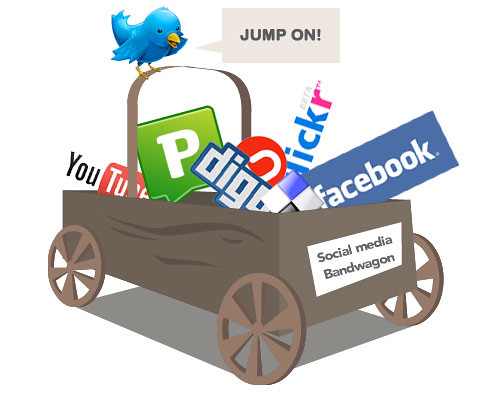
It is not too late to jump on the bandwagon. (Thanks to Matt Hamm for this image.) The challenge is how to make it work for you. It is not a question of if or when to use social media, but which tools and how.

Development Gateway uses a number of social media platforms to communicate with our stakeholders. The enhanced version of dgCommunities, the platform we provide for information on development, is scheduled for launch in the coming weeks. It will make sharing content easier and has been designed with social features. In addition to this blog, we use several other platforms such as Twitter.

We added Twitter to our toolbox because of its speed and flexibility. It is one way we share knowledge on what is going on in international development and inside the organization. It has helped us connect with people who care about aid effectiveness.

Twitter has been mentioned frequently in the news lately. First, as an application that will change the way we live, according to Time. Then, it was examined in light of the Iranian elections. More recently it became the subject of attention when Michael Jackson, the King of Pop, died on June 25, and tweets jumped to 5,000 a minute. (Sounds like a lot, doesn't?)

Our Twitter updates are integrated into a broader communications strategy that puts the Web site at the hub. Our tweets reference the Web site but go beyond our programs to help promote other notable efforts and engage in less formal conversations with our followers. Other tools, such as Facebook, LinkedIn, this blog, and the ning, are vehicles for communication and knowledge sharing. Each one has its own role. The trick is to use them well you need to be driving the wagon, not bouncing around in the back.

Friday, June 26, 2009

Six steps to managing an international team


by Alex Coleman

This is the first in a series of six blog entries describing the management process used by the AMP technical team. The team consists of 20 software engineers in Argentina, Burkina Faso, Georgia, Finland, Morocco, and Romania. We also have 6 technical specialists in Washington, Dakar, and Nairobi. The team supports 11 AMP installations in Bolivia, Burkina Faso, Burundi, DRC, Ethiopia, Malawi, Montenegro, Niger, Senegal, and Tanzania.

1. Over Communicate (Provide various channels of communication)

There can never be too much communication with your team horizontally and vertically. Communication is imperative because of the distance and increased probability of a misunderstanding of requirements. It helps foster the team spirit crucial to the success of the program.

The various methods of communication are:

  • Chat. On a daily basis, we use an internal chat system-AMPCHAT. All the technical team members are required to be available on this chat during work hours. We also use chat systems such as MSN, Skype, and YAHOO as backup options. Encourage developers in different countries to use the chat systems and SIP phones to discuss technical issues.

  • Webex. This online tools works well for international calls, demonstrations, and recording of meetings.

  • Teleconference. We hold a quarterly teleconference team meeting to outline the management and technical direction for the upcoming months.
  • E-mail. Electronic mail, combined with teleconferences and chats organized by technical specialists, is good for smaller teams for the kickoff and development of a new feature. Various daily meetings are held to discuss the feature requirements, project plan, and ongoing updates. These methods are also good for upgrade and installation planning.

  • Telephone. Old-fashioned technology still has its place. Phone interviews for new hires are important to encourage direct communication and a team spirit.

  • Face-to-face. Upon hire, new team members are paired up with senior developers. This sometimes takes place in another location. Working side by side for a period of two months helps the new hire to understand our software development process.
My next post will focus on step 2: Nurturing the team

Thursday, June 25, 2009

Holding donors accountable

by Emily Kallaur

The ONE Campaign recently released its DATA Report 2009, which tracks the G8 countries’ actual aid delivery against the pledges made at the 2005 Gleneagles summit. This report is a great example of leveraging aid information to hold development actors accountable for their promises. Overall, the analysis finds mixed performance across donor countries; in total, about one third of the aid increases promised by 2010 have been delivered. Clearly progress will have to accelerate if the targets are to be met (although some individual donors are meeting or even exceeding their individual commitments). In addition to increasing the quantity of aid, the report highlights the need to improve the quality of delivery—for example, relying on local country systems rather than donor systems to manage aid flows. But of course, aid is only part of the story. Having made little progress on “making trade work for Africa,” it’s time for the G8 to take some meaningful steps toward facilitating increased trading opportunities.

Wednesday, June 24, 2009

Five Sites Every Conscious Citizen Should Know About

by Nadia Afrin

Global Voices Online – www.globalvoicesoline.com
Want an alternative to mainstream news media? Want to know what people around the world are really thinking? Global Voices Online can give you the global pulse by aggregating commentaries from 200 bloggers worldwide. Global Voices also runs the Lingua project and translates blog entries in 15 languages.

Global Giving – www.globalgiving.com
Global Giving is the “marketplace that connects people who have community and world-changing ideas with people who can support them”. It compiles a list of credible development projects around the world and ensures that they meet IRS and anti-terrorism regulations. Individuals who are interested in donating to a good cause can find projects by sector and country. We set up a wedding registry on Global Giving when we got married and raised over 1,000 dollars for projects we picked out!

Ammado – www.ammado.com
Ammado is social networking site that brings together non-profts, socially-minded businesses, and conscious citizens around the world. Businesses can use it to promote awareness about their CSR initiatives as well as forge partnerships. Non-profits can communicate information about their activities to people around the world. Individuals can get up-to-date information about their favorite non-profits, create giving circles to fund development projects and connect with like minded people. Since its launch in June 2008 the membership of Ammado has grown substantially. The site is now available in 12 languages.

TED – www.ted.com
TED was created on the notion that ideas have the power to change our world. TED hosts an annual conference that brings together thinkers and leaders in science/technology, business, arts etc. 400 of the best TEDTalks are available on their website with subtitles in various languages.

dgCommunities – www.dgcommunities.com
Last but not the least is our very own dgCommunities. It provides a space for professional learning and knowledge-sharing among those working to reduce poverty worldwide. We are making big improvements to dgCommunities and rebranding it in an effort to better meet your needs. Among other things, we are expanding out coverage from the current 30 topics to a wide range of development issues. Look out for the new and improved dgCommunities!

Monday, June 22, 2009

Putting on a human face


by Elizabeth Corley

Last week we met in person with one of the co-hosts of the Open Development camp, Sameer Vasta. He’s been hired as the social media strategist for the World Bank—a man whose job entails putting a human face on a large bureaucratic institution.

One step in his strategy was to start a blog to explore the intersection of the Web and the World Bank. I particularly like his Friday reading list posts.

http://blogs.worldbank.org/insidetheweb/

We’re trying to put a human face on Development Gateway. The task is not so daunting for an organization with fewer than 100 staff. One of our strengths is our diversity; we have an interesting mix of development practitioners and IT programmers. Headquartered in DC, we have a corporate office in Brussels and two satellite offices in Africa. Programmers are based in Argentina, Armenia, Georgia, Romania, and Ukraine. This blog is intended in part to serve as window into the organization, one which allows others to view the many facets of Development Gateway.

Like a Cubist painting, we want to show you various perspectives at the same time. This interdisciplinary approach reflects how we work together as team to provide services to our stakeholders.