Tuesday, April 13, 2010

Good Neighbor Policies

In the wake of the tragic crash on Saturday that killed key members of the Polish government, I want to express my heartfelt condolences to the Polish people and the friends and families of those involved. But because this is a blog about development, I also wanted to take this opportunity to share some insights on a topic that is all too often overlooked---Polish development assistance. Although popular perception often portrays Poland as a country in transition just barely overcoming the shadow of Soviet rule, in the aid world at least quite the opposite is true. The AidData project shows that despite the economic hardships of the 1990s, Poland began giving money away as early as 2004 (and likely earlier). According to the information in AidData, Poland funded or partially funded almost 1,000 aid activities between 2004 and 2007.
One of the most interesting things to note about Polish aid is where the money goes. Far more so than much larger donors like the United States, Poland seems to be keeping its funds in the neighborhood. The vast majority of Polish development assistance goes to Eastern European countries, an indication perhaps of Poland’s interest in assisting countries with a similar history to its own.
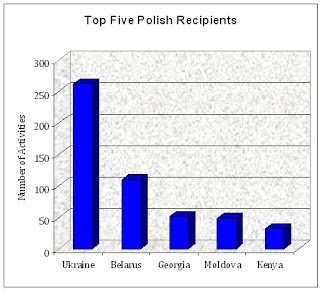
However, Poland also appears to look after its own citizens abroad. AidData reveals how Poland consistently funds activities in countries where Polish troops or peacekeepers are stationed.
In fact, Eastern Europe now boasts a number of donors who just a decade or two ago were still receiving large amounts of aid. The Czech Republic, Estonia, Hungary, Latvia, Lithuania, and the Slovak Republic all now give development assistance, most of it within the region.


As foreign assistance shifts farther and farther away from traditional lending from large Western countries, it will be interesting to keep an eye on Poland and other smaller donors. After all, everyone has to start somewhere.
Friday, April 9, 2010

Where Have the Cows Gone?


This week Development Gateway attended the first meeting of the advisory committee for InterAction's Mapping Initiative. InterAction, for those who don't know, is an umbrella organization that represents hundreds of U.S. non-governmental organizations. Together with FortiusOne (the organization behind the incredibly cool Geocommons online mapping tool), InterAction is working with a small group of their member organizations to create a standard output format for NGO development projects so they can be easily compared and, of course, mapped. Although the location of aid projects will likely be aggregated at the provincial level to protect the privacy of the recipients, this tool could in theory create a map that displayed where each cow that Heifer International donated had gone. It could probably even make the points spotted.

The implications for aid transparency are enormous. Thousands of NGOs are involved in international development, and at the moment there is no systematic way for stakeholders to look at where these organizations are operating and what is being funded. If a picture is worth 1,000 words, imagine a map that could overlay the work of 1,000 organizations against indicators like child malnutrition or climate vulnerability to show areas where help is still needed. Knowledge is a powerful tool.

Thursday, April 8, 2010

Intern blog: Haiti & aid transparency

With warmer weather and the rainy season on the way, celebrities are also joining in on efforts to provide Haiti with basic supplies, such as waterproof tents. Although aid to Haiti is clearly still much needed, aid workers and politicians are having difficulty agreeing on what will best deliver a speedy recovery and overall improvement in the country's economic, social, and institutional development. So what will have the greatest impact? Investment in education, as Canadian governor Michaelle Jean says? Or as Nancy Birdsall argues, allowing more Haitians in the United States so they can bring back the expertise they gain abroad? How should donors and the Haitian government prioritize and allocate funds towards immediate needs and long-term development goals?

Amidst these debates, the broader issues of aid effectiveness are brought to the forefront. What have donors promised and what are the actual results? How can countries become active participants in the aid process? Haiti's Prime Minister Jean-Max Bellerive has stated his commitment to transparency, a vital part in ensuring that the large amounts of aid flowing into the devastated country are used to promote recovery. Development Gateway and its partners are also working towards this end by providing a system that allows the Haitian government to track damage reports. With technology bringing the world closer together, it's certainly much simpler to get information out there to those who need it. No wonder that ICT is one of the fastest growing sectors in development.

Tuesday, March 30, 2010

AidData: Aid Transparency in Action

This week has been very exciting for those of us here at Development Gateway, particularly the AidData team. After nearly seven years in development, the AidData web portal---along with its nearly 1 million development assistance activity records---was finally made available to the public. The beta version of the site allows users to search for detailed information on aid activities from 80 donor governments and multilateral organizations worldwide. AidData was revealed midway through the Aid Transparency and Development Finance: Issues and Insights from AidData conference that took place over three days at University College in Oxford. Participants engaged in lively discussion about the web portal, data standards, aid transparency, and the 24 papers and numerous presentations of cutting-edge research using AidData. Anyone interested could also attend a demonstration of how to use the tool to answer their own questions about development finance.

The best news for the team, however, has been the overwhelmingly positive feedback that AidData has gotten since going public. In its first week, the website had over 30,000 hits and AidData has been mentioned in dozens of high-profile blogs and news outlets as a positive influence on aid transparency and effectiveness.

To check out AidData, go to www.AidData.org.

Thursday, March 4, 2010

Intern blog: Aid Information Challenge

If you've been following our Twitter, you may know that we're holding an unconference/bar camp, Aid Information Challenge, this month to discuss how data can used to improve aid efficiency. Development Gateway's databases compile information about international aid so that it's more accessible to international development professionals, but also the public. AidData, which is a database of extensive statistical data on international aid, will also be launched in March at Oxford in conjunction with BYU and William & Mary. So it's a pretty exciting time for Development Gateway!

In the process, I've been spreading the word and got to thinking about the core purpose of these events. There seems to be a general consensus now that transparency is crucial for development aid. Not only are we striving to do this with our programs and technology, but we are also trying to achieve this through the unconference. In a field or within an organization, encouraging dialogue and input is a great way to facilitate new ideas.  We're providing the statistics and data and you can help us come up with effective ways to use and implement it!